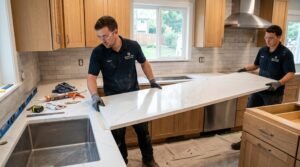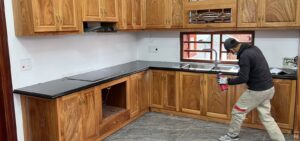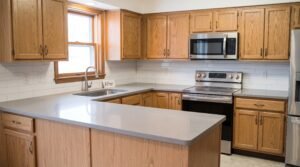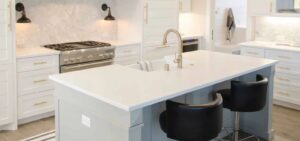
The question that most homeowners don’t ask when selecting quartz or granite for their Denver home in 2026 is which one will I regret? When it is not installed day, when both look fantastic. Three years in, when the quartz near the kitchen window has shifted color, or the granite has absorbed a bottle of red wine because the sealing schedule slipped. This year the price difference between these two materials has all but disappeared, import tariffs have realigned the material supply and price, and quartz product offerings are better than ever. All the more so the wrong choice is easy to make than ever. Here are the steps to creating the most appropriate one.
What the Denver Climate Does to Your Countertop Decision
It is one thing that you won’t find in the typical countertop guide but it’s something that is important here. The elevation of Denver is 5,280 ft, and the low average humidity is around 40% to 50% for the year, compared to coastal cities which routinely achieve over 70% humidity. Natural stone is impacted by that dry environment.
Granite is more likely to keep itself sealed between applications in low-humidity climates. That moisture cycling, which contributes to sealer breakdown in humid environments, increases and decreases the stone’s porous structure as humidity increases and decreases, is much less noticeable in Denver’s dry air. If a granite countertop is used in a coastal kitchen and needs to be resea lled every 12 months, then it is reasonable to expect that in Denver it could be resea lled every 18 months and still retain a stain resistant surface.
The flip side is that Denver’s 300-plus days of annual sunshine create significant UV exposure in south and west-facing kitchens. It is directly tied to the problem that quartz polymer resins used in engineered stone can break down over time from UV exposure and kitchens with big windows that face Colorado’s intense high altitude sunlight can experience quartz discoloring between 5-8 years after its installation.
How Each Material Performs in a Working Kitchen
Quartz Performance
Quartz is a man-made stone that is 90-94% ground quartz crystals and bound with polymer resins. No sealing, no coffee, wine or turmeric staining, and easy to clean with a damp cloth. With the zero maintenance angle, this is a real benefit for busy Denver families who have children, a lot of entertaining going on or an open floor plan kitchen that sees daily use.
Heat is where quartz has a documented limitation. Polymer resins will start to degrade at temperatures over 300°F. Any cast iron skillet removed from the heat and placed on quartz can lead to a permanent stain or damage to the surface. Instead of being an optional item, trivets are a must-have. This can be a real hassle for those who cook up a lot and transport hot tools and pans around the house often.
Granite Performance
Granite is an igneous rock that is composed of quartz, feldspar, and mica that have fused together under geologic pressure. It is located on the 6th to 7th position on the Mohs hardness scale and will not be affected by direct heat contact. Nothing happens if a 450°F Dutch oven is placed on granite. For Denver households built around serious cooking batch cooking, canning, high-volume meal prep that heat tolerance is a practical daily advantage quartz cannot match.
Because of its porous nature, granite needs to be sealed every so often with a penetrating impregnator sealer. Over time, without it, red wine, olive oil and dark liquids will seep into the stone. Sealing is one thing that doesn’t need to be done every year with Denver’s long schedule, and is manageable if it’s done properly.
The Visual Difference and Why It Matters
Granite is one of the rare types of rocks in the Earth. No two slabs from a Brazilian, Indian or Norwegian quarry have the same mineral pattern. When it comes to high character looks and natural style, especially in mountain contemporary or craftsman homes, natural materials play well with wood and stone; granite provides something that no amount of money spent on engineered stone can duplicate.
Quartz offers controlled consistency. The veining, colour and pattern is produced according to the specifications, making it much easier to install large format or to match between multi slabs. When it comes to matching adjacent quartz slabs, it’s easy in an open-plan kitchen with a large island and perimeter countertops 40 linear feet or longer a common way to floor Denver’s newer builds and remodels a way that natural granite never completely provides.
Quartz products in 2026 have taken visual quality to a whole new level from five years ago. Brands such as Cambria, Silestone and MSI are actually making slabs with movement and veining depth that actually come close to the natural stone on a level visual. But under close inspection and in natural Colorado light, the difference between engineered and geological remains visible to anyone looking for it.
Cost Breakdown for Denver in 2026
Import tariff adjustments on Brazilian and Indian stone, combined with increased domestic fabrication costs, have shifted countertop pricing across the board this year.
Quartz Pricing in Denver
- Entry-level quartz: $65 to $85 per square foot installed
- Mid-grade quartz (Silestone, MSI Calacatta): $90 to $120 per square foot installed
- Designer quartz (Cambria, premium Caesarstone): $130 to $160 per square foot installed
Granite Pricing in Denver
- Standard granite (Black Galaxy, Uba Tuba, Santa Cecilia): $55 to $80 per square foot installed
- Mid-grade granite (Kashmir White, Giallo Ornamental): $85 to $115 per square foot installed
- Exotic granite (Blue Bahia, Van Gogh, Calacatta Macaubas): $120 to $160 per square foot installed
At the mid-grade tier, both materials now occupy nearly the same price band. The decision at that price point is not about cost it is about performance priorities and aesthetic direction.
Edge profiles, undermount sink cutouts, and cooktop openings all add to fabrication costs regardless of material. A kitchen with a waterfall island edge and apron-front sink cutout will see those additions push total project cost by $800 to $1,500 depending on complexity.
Resale Value in the Denver Market
Denver’s real estate market in 2026 continues to place strong value on kitchen finishes, particularly in the $600,000 to $1.2 million segment where kitchen quality directly influences buyer perception and offer strength. In that context both quartz and granite are signals of quality – neither are bad to buyers.
The difference lies in the luxury/mountain sector over $1.5 million. Natural stone has a authenticity of material which is not quite as genuine in the high-end buyer’s eyes as engineered products. Granite and marble countertops in that price range send a value message that quartz no matter the quality, doesn’t always convey.
The most important factors for standard residential remodel jobs that are expected to be sold within 5 to 10 years are the surface quality and the quality of the installation work done.
Which One Is Right for Your Kitchen
Quartz carries many more practical arguments for Denver homes with kids, daily use, and an open floor plan with ample exposure to the south or west sun, the only time it’s a long-term problem is when UV degradation is a factor. Also, it’s good for other properties like a rental or second home that may not have the same level of maintenance attention.
The stronger argument for granite is for serious cooks who prefer to have a heat resistant kitchen, for homeowners who want geological uniqueness in their kitchen, and some luxury properties where natural stone counts more toward resale. Denver’s dry climate also contributes to a longer sealing interval for granite than the other markets, which minimizes the maintenance interval between two materials.
Conclusion
The best countertop isn’t necessarily the winning material, it’s the one that fits your kitchen’s usage and style. However, in the unique situation of Denver’s climate, with its UV levels and low humidity, the UV sensitivity of quartz, and the extra long sealing time of granite, is an important consideration that most guides don’t even mention.
Denver Countertop Designs is your local source of knowledge, craftsmanship and expertise in choosing slabs, fabricating them precisely, and installing them properly, both on quartz and granite surfaces, to assure the surface you select will perform and look exactly the way you want for the next 20 years.